Signs Your Insulin Resistance Is Reversing — The Changes Most Women Miss in the First 12 Weeks

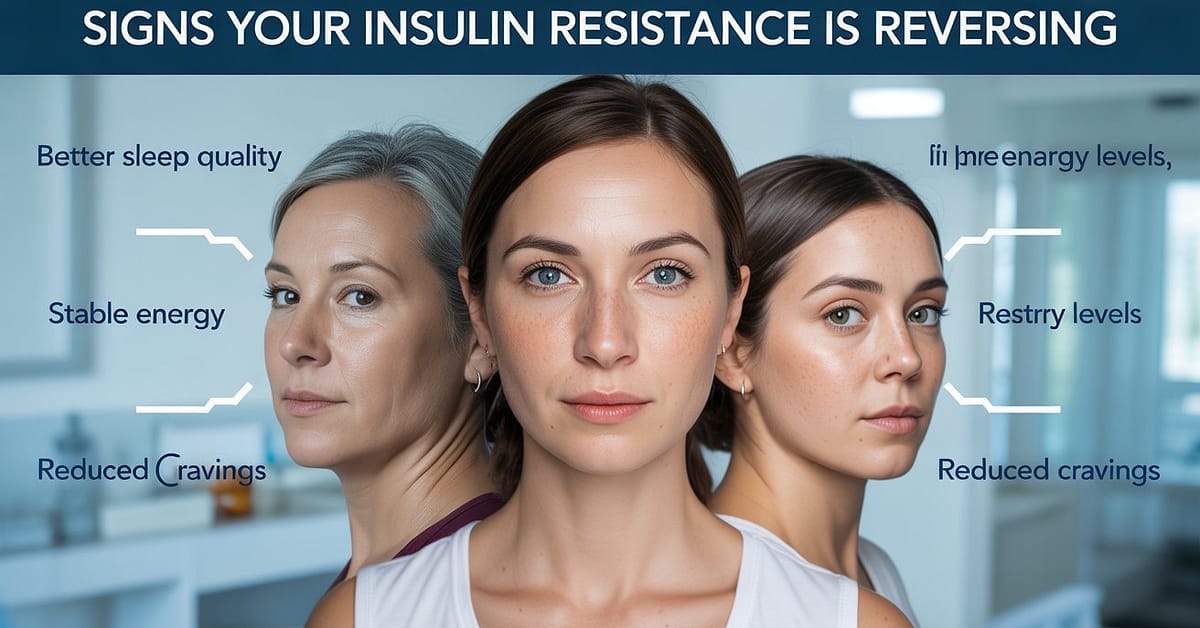
Quick Reference Box
| Sign of Reversal | When It Typically Appears | What It Means |
|---|---|---|
| Post-meal energy stable | Week 1–2 | Postprandial insulin spikes reducing |
| Afternoon sugar cravings reduce | Week 2–3 | Fasting insulin beginning to normalize |
| Sleep quality improves | Week 2–4 | Cortisol-insulin loop stabilizing |
| Waist circumference decreasing | Week 4–8 | Visceral fat reducing — key metabolic marker |
| Triglycerides falling | Week 6–10 | Liver insulin resistance improving |
| Acanthosis nigricans lightening | Month 2–3 | Chronic hyperinsulinemia declining |
| Menstrual cycles regularizing | Month 2–4 | Androgen-insulin loop resolving (PCOS) |
| HOMA-IR dropping on blood test | Week 8–12 | Confirmed metabolic reversal |
Introduction
Signs your insulin resistance is reversing are often subtle, appear before any blood test confirms change, and are almost universally missed because nobody tells women what to look for. Most health guides focus on what insulin resistance looks like — not what improvement looks like. For women aged 30 to 50 implementing dietary, exercise, and lifestyle changes, the body sends clear, measurable signals that the condition is responding — weeks before HOMA-IR normalizes on a blood test. According to the CDC, 115.2 million American adults have prediabetes, and most who attempt reversal have no framework for tracking progress. This article provides that framework — with the research behind every marker.
Why Recognizing Reversal Signs Matters
The biggest threat to sustained insulin resistance reversal is not the difficulty of the protocol — it is the absence of visible feedback in the early weeks. Women who cannot see or feel improvement abandon interventions before they have had time to produce measurable blood test changes.
Understanding the reversal timeline matters for three specific reasons:
- Symptom changes precede blood test changes. How you feel after meals, how you sleep, and how your cravings behave all shift before fasting insulin normalizes on a lab test. Recognizing these early signals is the difference between staying motivated and giving up in week 3.
- The wrong markers create false discouragement. Scale weight is a poor early marker of insulin resistance reversal. A woman can be actively reversing insulin resistance — losing visceral fat, reducing fasting insulin, improving HOMA-IR — while the scale remains unchanged because she is simultaneously building muscle tissue.
- Tracking reversal signs accelerates the process. When you can identify which interventions are working — because you observe the symptom changes they produce — you can reinforce those behaviors and eliminate the ones that are not producing change.
👉 Track your baseline: Free HOMA-IR Insulin Resistance Calculator
The Symptoms That Were Present — And Now Are Changing
Before understanding reversal signs, it is important to anchor them to the presenting symptoms they replace. Women with insulin resistance typically experience:
- Post-meal fatigue and energy crashes 60 to 90 minutes after eating
- Intense afternoon sugar or carbohydrate cravings that feel compulsive
- Stubborn belly fat unresponsive to caloric restriction
- Brain fog and poor concentration after carbohydrate-heavy meals
- Dark, velvety skin patches on the neck or underarms (acanthosis nigricans)
- Irregular menstrual cycles or severe PMS in the luteal phase
- Skin tags on the neck, eyelids, or armpits
- Poor or non-restorative sleep despite adequate hours
- Persistent high blood pressure despite otherwise normal lifestyle factors
Every one of these symptoms has a specific biological mechanism driving it. And every one of those mechanisms produces a measurable change as insulin resistance reverses. The reversal signs track directly back to the resolution of these mechanisms.
Main Causes — Why These Signs Appear During Reversal
Falling Fasting Insulin — The Root Change
Every sign of insulin resistance reversal traces back to one primary event: fasting insulin beginning to fall. As the dietary and lifestyle interventions reduce the chronic postprandial insulin demand, the pancreas produces less compensatory insulin. Fasting insulin drops. And as fasting insulin drops, the downstream effects — visceral fat accumulation, androgen excess, skin changes, energy dysregulation — begin reversing in order of their proximity to the insulin signal.
GLUT4 Upregulation — Muscle Cells Getting Responsive Again
Research published in PMC on GLUT4 and exercise confirms that exercise-induced GLUT4 upregulation in skeletal muscle — the primary mechanism of insulin sensitivity improvement — produces acute changes in glucose clearance within hours of a single session, and structural changes in GLUT4 transporter density within 8 weeks of consistent training. As muscles become more insulin-responsive, less insulin is needed to clear postprandial glucose — and every symptom driven by hyperinsulinemia begins to improve.
Visceral Fat Reduction — The Inflammatory Signal Decreasing
Visceral fat releases inflammatory cytokines — TNF-alpha and interleukin-6 — that directly impair insulin receptor signaling. Research from PMC on waist circumference and insulin resistance confirms that waist circumference explains more than 50% of the variation in insulin sensitivity — meaning as waist circumference decreases, insulin sensitivity improves in near-direct proportion. This is why waist circumference reduction is one of the earliest and most reliable objective signs of insulin resistance reversal.
The Androgen-Insulin Loop Unwinding
For women with PCOS-related insulin resistance, falling insulin directly reduces ovarian testosterone production. Research confirms that insulin stimulates ovarian androgen synthesis — and that as hyperinsulinemia resolves, ovarian testosterone output declines. This produces measurable changes in menstrual cycle regularity, acne patterns, and hirsutism in women with PCOS-driven insulin resistance.
The Science — What the Body Does When Insulin Resistance Improves
The reversal of insulin resistance produces cascading changes across multiple organ systems simultaneously. Understanding which system changes first — and why — allows women to interpret their own symptom patterns accurately.
Skeletal muscle responds first — within hours of exercise, GLUT4 translocation improves glucose uptake without insulin. This produces the immediate post-exercise energy improvement many women notice within the first week of implementing a resistance training protocol.
The pancreas responds next — as the insulin demand from meals decreases (through dietary changes) and insulin-independent glucose clearance increases (through exercise), the compensatory hyperinsulinemia begins to fall. Fasting insulin starts dropping within 1 to 2 weeks of consistent dietary change.
The liver responds more slowly — hepatic insulin resistance, driven by intramyocellular and intrahepatic fat, takes 6 to 12 weeks to show measurable improvement. This is reflected in falling triglycerides on blood panels — one of the most reliable objective markers of improving liver insulin resistance.
The skin responds last — acanthosis nigricans, driven by hyperinsulinemia stimulating keratinocyte and fibroblast proliferation through IGF-1 receptors, begins lightening only after sustained reduction in chronic insulin levels. Research from PMC on skin manifestations of insulin resistance confirms that skin manifestations including acanthosis nigricans are directly driven by hyperinsulinemia and IGF-1 receptor activation — and begin reversing as hyperinsulinemia resolves.
What the Research Shows — 2 Key Studies
Study 1 — Exercise Interventions Reduce HOMA-IR Across 9 Different Modalities
A 2025 systematic review and network meta-analysis published in Frontiers in Endocrinology examined 21 randomized controlled trials involving 1,140 participants with diabetes and analyzed 9 different exercise modalities for their effect on fasting glucose, fasting insulin, and HOMA-IR. Resistance exercise produced the highest HOMA-IR reduction efficacy (SUCRA score = 71.8%) among all single exercise modalities. The combination of resistance and running produced the greatest HOMA-IR reduction (SUCRA score = 64.2%). The finding confirms that strength training — producing GLUT4 upregulation in skeletal muscle — is the exercise modality with the strongest evidence base for reversing insulin resistance, and that the combination of resistance and aerobic exercise accelerates the process beyond either approach alone.
What this means for tracking reversal: Women who implement resistance training 3 times per week should expect measurable HOMA-IR improvement within 8 to 12 weeks — and can track this with the subjective markers described below in the intervening weeks.
Study 2 — TG/HDL Ratio From NHANES Data Correlates Strongly With Insulin Resistance in US Adults
A cross-sectional study published in Endocrine Connections examined 10,132 participants from the NHANES dataset (2009 to 2018), representing the American population. The study confirmed that the triglyceride-to-HDL ratio is significantly associated with insulin resistance across all racial and demographic groups in the US. Participants were divided into insulin-resistant and non-insulin-resistant groups using HOMA-IR 2.73 as the cut-off value. The TG/HDL ratio in the insulin-resistant group was significantly higher than in the non-insulin-resistant group across all sub-analyses.
What this means for tracking reversal: Falling triglycerides and rising HDL on a standard blood panel are reliable, accessible markers of improving insulin sensitivity — calculable from any standard lipid panel without requiring a fasting insulin test. A TG/HDL ratio falling below 3.0, and eventually below 2.0, reflects genuine metabolic improvement in the liver and adipose tissue.
Health Risks of Stopping Too Early
Understanding the reversal signs is equally important for knowing when NOT to stop the intervention. Many women experience early symptom improvement — better energy, reduced cravings — and incorrectly assume the problem is resolved. The risks of premature discontinuation are significant:
Relapse is rapid. Insulin resistance returns faster than it resolves. Returning to the dietary and lifestyle patterns that created the condition — even partially — can re-establish chronic hyperinsulinemia within weeks.
Symptom improvement precedes full metabolic normalization. Feeling better in week 3 does not mean HOMA-IR has normalized. Most women need 12 to 24 weeks of sustained intervention to achieve objective blood test normalization. Early symptom improvement is a confirmation the approach is working — not a signal to stop.
Pancreatic beta cell protection requires sustained reversal. The longer chronic hyperinsulinemia persists, the more progressive beta cell exhaustion occurs. Each period of relapse imposes additional beta cell stress. Sustained reversal — confirmed by HOMA-IR testing — is the only way to meaningfully reduce the risk of progression to prediabetes and Type 2 diabetes.
12 Signs Your Insulin Resistance Is Reversing — In Order of Appearance
Signs 1–3: Appearing in Weeks 1 to 2
Sign 1 — Stable Energy After Meals The first and fastest sign of insulin resistance reversing is the resolution of post-meal energy crashes. When insulin demand decreases — because dietary carbohydrate quality has improved and protein intake has increased — the sharp postprandial insulin spike blunts. Blood glucose no longer drops sharply after eating. Women notice they can reach 2 to 3 hours after a meal without fatigue or urgent hunger. This change can appear within days of implementing consistent protein-first meal sequencing and eliminating refined carbohydrates.
Sign 2 — Reduced Afternoon Sugar Cravings Compulsive afternoon cravings for sugar or bread are driven by the hypothalamic response to cellular glucose deficiency — caused by insulin resistance in muscle and brain tissue. As insulin sensitivity improves and cells absorb glucose more efficiently, the hypothalamic starvation signal weakens. Women report that the urgent, almost uncontrollable quality of afternoon cravings diminishes — they may still want something sweet, but the physical compulsion resolves. This sign typically appears in weeks 1 to 3.
Sign 3 — Improved Mental Clarity After Meals Brain insulin resistance produces the post-meal brain fog and difficulty concentrating that many women attribute to “just being tired.” As insulin sensitivity in neuronal tissue improves, glucose transport into brain cells normalizes. The clearer head that follows meals — the ability to concentrate and think sharply in the 1 to 2 hours after eating — is an early neurological sign that insulin signaling is recovering.
Signs 4–6: Appearing in Weeks 2 to 4
Sign 4 — Better Sleep Quality Insulin resistance and cortisol are tightly linked. High cortisol elevates blood glucose and drives the 11-beta-HSD1 activation in visceral fat that worsens insulin resistance. As fasting insulin begins to fall, the cortisol-insulin feedback loop stabilizes. Women notice they fall asleep more easily, stay asleep through the night, and wake feeling more rested — even before waist circumference or lab values have changed significantly.
Sign 5 — Morning Hunger Is Appropriate, Not Urgent Chronic hyperinsulinemia produces reactive hypoglycemia — sharp blood glucose drops that drive aggressive morning hunger, sometimes accompanied by shakiness or irritability. As fasting insulin normalizes, blood glucose stays stable through the night and into morning. Hunger at breakfast becomes moderate and can be easily delayed — not the urgent, shaky hunger of chronic hyperinsulinemia.
Sign 6 — More Consistent Energy Throughout the Day The “energy peaks and crashes” pattern of insulin resistance — feeling good after breakfast, crashing by 10 AM, recovering after lunch, crashing again by 3 PM — reflects the postprandial insulin-glucose rollercoaster. As insulin sensitivity improves, blood glucose stabilizes and the daily energy pattern smooths. Women describe this as “flat energy” — not the highs and lows, but a consistent, moderate energy level throughout the day.
Signs 7–9: Appearing in Weeks 4 to 8
Sign 7 — Waist Circumference Decreasing This is the most important objective at-home sign of insulin resistance reversal. Research from PMC on waist circumference and metabolic syndrome confirms that waist circumference is the single most predictive anthropometric factor for insulin resistance. As visceral fat reduces, insulin resistance improves — and waist circumference falling below 35 inches in women is a clinically meaningful threshold.
Measure waist circumference every 4 weeks — not daily. A reduction of 0.5 to 1 inch per month in the first 8 weeks is a reliable sign the protocol is working. Track the trend, not the single number.
Sign 8 — No New Skin Tags Developing Research published in PMC on skin manifestations of insulin resistance confirms that skin tags (acrochordons) are driven by hyperinsulinemia stimulating fibroblast and keratinocyte growth through IGF-1 receptor activation. Importantly, existing skin tags do not reverse with insulin normalization — they remain unless removed. However, the cessation of new skin tag formation is a clear sign that chronic hyperinsulinemia is resolving. Women who were developing new skin tags every few months notice that new formation stops within 6 to 10 weeks of sustained intervention.
Sign 9 — Reduced Bloating and Water Retention Excess insulin causes the kidneys to retain sodium, which produces water retention and bloating — particularly in the days before menstruation. As fasting insulin falls, renal sodium retention decreases. Women notice reduced puffiness, better-fitting rings and shoes in the morning, and reduced perimenstrual bloating. This is a direct renal sign that hyperinsulinemia is resolving.
Signs 10–12: Appearing in Weeks 6 to 12+
Sign 10 — Triglycerides Falling on Blood Panel Falling triglycerides are the most reliable blood-based early marker of improving insulin resistance — and are available from a standard lipid panel without requiring a fasting insulin test. Research from Lipids in Health and Disease confirms that triglycerides are independently correlated with insulin resistance and beta cell function. As liver insulin resistance improves — through dietary fructose elimination and reduced de novo lipogenesis — fasting triglycerides fall. A triglyceride reading below 100 mg/dL, alongside an HDL above 60 mg/dL in women, reflects good insulin sensitivity.
Sign 11 — Acanthosis Nigricans Beginning to Lighten The dark, velvety patches on the neck and underarms that characterize insulin resistance are driven directly by hyperinsulinemia. Research from PMC on skin manifestations of insulin resistance confirms these patches result from hyperinsulinemia activating IGF-1 receptors in keratinocytes — stimulating excess skin cell proliferation. As chronic hyperinsulinemia resolves, IGF-1 receptor stimulation decreases and the skin patches begin lightening. This typically begins at 2 to 3 months of sustained improvement and continues over 6 to 12 months.
This sign appears late — but it is one of the most confirming. When acanthosis nigricans begins lightening, it means chronic systemic hyperinsulinemia has been reduced significantly enough to affect dermatological tissue. That is a meaningful level of metabolic change.
Sign 12 — Menstrual Cycle Regularizing (For Women With PCOS) The PCOS-insulin loop — where excess insulin stimulates ovarian testosterone, which worsens insulin resistance — begins unwinding as fasting insulin falls. Women with PCOS who had irregular cycles of 35 to 60+ days typically begin seeing cycles regularizing toward 28 to 35 days within 2 to 4 months of sustained insulin resistance reversal. This is one of the most emotionally significant reversal signs for women actively trying to conceive, and one of the most research-supported markers of genuine metabolic improvement.
👉 Related: Insulin Resistance Treatment in Females
Natural Solutions — What Produces the Reversal Signs Fastest
The reversal signs described above appear as direct consequences of specific interventions. Match the intervention to the sign you want to see first:
- For energy stability and craving reduction (Week 1 to 2): Eliminate refined carbohydrates completely, implement protein-first meal sequencing (30 to 40g protein before any carbohydrate), walk 10 minutes after each meal
- For sleep improvement (Week 2 to 4): Protect 7 to 9 hours of sleep, no screens 60 minutes before bed, magnesium glycinate 300 to 400 mg before sleep, limit caffeine after noon
- For waist circumference reduction (Week 4 to 8): Resistance training 3 times per week, eliminate alcohol during the reversal phase, eliminate dietary fructose and seed oils
- For triglyceride improvement (Week 6 to 10): Eliminate added sugars and high-fructose corn syrup, increase omega-3 intake through wild-caught salmon and sardines, implement time-restricted eating within a 10 to 12-hour window
- For acanthosis nigricans lightening (Month 2 to 3+): Sustained reduction in fasting insulin through all of the above — this sign requires the longest consistent intervention before it appears
👉 Related: What Is the Fastest Way to Cure Insulin Resistance? The Truth Explained
Best Foods That Accelerate the Reversal Signs
| Food | Which Reversal Sign It Supports | Mechanism |
|---|---|---|
| Wild-caught salmon | Triglycerides falling, inflammation reducing | Omega-3s reduce hepatic triglyceride production |
| Eggs (whole, 3–4 per meal) | Energy stability, craving reduction | High protein stabilizes postprandial glucose |
| Lentils and chickpeas | Craving reduction, energy stability | High fiber + protein; GI index 21–28 |
| Leafy greens (spinach, kale) | All reversal signs | Magnesium cofactor in insulin receptor signaling |
| Avocado | Triglycerides, waist reduction | MUFA reduces hepatic fat accumulation |
| Blueberries | Energy stability, inflammation | Low glycemic; polyphenols reduce TNF-alpha |
| Apple cider vinegar (before meals) | Post-meal energy stability | Slows gastric emptying; blunts glucose spike |
| Broccoli | Liver insulin resistance, triglycerides | Sulforaphane reduces hepatic glucose production |
| Plain full-fat Greek yogurt | Gut-hormone axis, energy stability | Protein + probiotics improve metabolic markers |
| Cinnamon | Craving reduction, energy stability | Cinnamaldehyde mimics insulin receptor signaling |
Foods That Slow or Reverse the Reversal Signs
Refined Grains and White Starches
White bread, white rice, pasta, and breakfast cereals sustain the postprandial insulin spikes that block every reversal sign from appearing. These foods prevent the energy stability, craving resolution, and fasting insulin normalization that the reversal process requires. They cannot be moderated during active reversal — they must be eliminated.
Added Sugars and Fructose
Fructose sustains hepatic de novo lipogenesis — keeping triglycerides elevated and liver insulin resistance active. Eliminating added sugars and high-fructose corn syrup is the fastest dietary change for improving the triglyceride-based reversal marker.
Alcohol
Alcohol suppresses slow-wave sleep (blocking the growth hormone release that supports metabolic repair), raises cortisol, and impairs hepatic glucose regulation. For women tracking reversal signs — particularly sleep improvement and triglyceride reduction — alcohol elimination is non-negotiable during the active reversal phase.
Industrial Seed Oils
Soybean oil, corn oil, canola oil, and sunflower oil promote the systemic inflammation that blocks insulin receptor signaling. Replacing these with extra virgin olive oil and avocado oil reduces one of the key inflammatory inputs that prevents reversal signs from appearing.
Expert Tips — How to Track Your Reversal Accurately
Photograph your acanthosis nigricans every 4 weeks. Lightening of dark neck and underarm patches occurs gradually enough that it is invisible day to day — but clearly visible when comparing month-1 and month-3 photographs. This photographic documentation provides powerful objective evidence of metabolic improvement that sustains motivation through the full reversal timeline.
Calculate your TG/HDL ratio from your existing blood work. Take your most recent triglyceride value and divide it by your HDL value. A ratio above 3.0 indicates insulin resistance. A ratio below 2.0 indicates good insulin sensitivity. This calculation is free, requires no additional testing, and provides an immediate baseline marker to track against as interventions produce improvements in subsequent panels.
Measure waist circumference on a fixed schedule — not daily. Weekly measurements are subject to hydration variation, hormonal water retention, and digestive transit variability. Measure every 4 weeks, at the same time of day, in the same conditions. A downward trend of 0.5 to 1 inch per 4 weeks in the first 3 months is a reliable confirmation the protocol is working.
Retest HOMA-IR at week 8 and week 16. Subjective signs confirm the direction of change. Objective blood tests confirm the magnitude. Plan your fasting insulin retests at 8-week intervals during the active reversal phase — this spacing allows enough time for meaningful HOMA-IR changes to accumulate while providing regular accountability checkpoints.
Distinguish between “the scale is not moving” and “reversal is not happening.” A woman simultaneously losing visceral fat and building muscle tissue can maintain the same body weight while her HOMA-IR normalizes completely. Scale weight is among the worst early markers of insulin resistance reversal. Waist circumference, energy patterns, craving behavior, sleep quality, and eventually blood test values are the markers that matter.
Key Takeaways
- Signs your insulin resistance is reversing appear in a predictable sequence — subjective energy and craving changes first, then measurable anthropometric changes, then blood marker improvements, then dermatological changes last
- Post-meal energy stability and reduced afternoon cravings are the earliest signs — appearing in weeks 1 to 2 of consistent intervention — reflecting the direct reduction in postprandial insulin demand
- Waist circumference reduction is the most important objective at-home marker — research from PMC confirms waist circumference explains more than 50% of insulin sensitivity variation
- Falling triglycerides and rising HDL on a standard blood panel confirm improving liver insulin resistance — the TG/HDL ratio from NHANES data is a validated US population marker of insulin resistance status
- Acanthosis nigricans lightening confirms that chronic systemic hyperinsulinemia has been sufficiently reduced to affect dermatological tissue — a late but highly meaningful sign
- Resistance training is the exercise modality with the highest HOMA-IR reversal efficacy per the 2025 Frontiers in Endocrinology meta-analysis
- The absence of scale weight change is not evidence that reversal is failing — track the right markers: waist circumference, energy patterns, craving behavior, sleep quality, TG/HDL ratio, and HOMA-IR at 8-week intervals
Frequently Asked Questions
How soon do you feel better when reversing insulin resistance?
Most women notice the first signs — stable energy after meals and reduced afternoon sugar cravings — within 7 to 14 days of eliminating refined carbohydrates and implementing protein-first meal sequencing. These early changes reflect the immediate reduction in postprandial insulin demand, not yet the structural cellular changes that take 8 to 12 weeks to develop. Feeling better in week 2 is a real sign of improvement — and evidence the approach is working — but sustained intervention for 12 or more weeks is required for objective blood test normalization.
Does acanthosis nigricans go away when insulin resistance reverses?
Acanthosis nigricans begins lightening — but typically does not disappear completely — as insulin resistance reverses. Research from PMC on skin manifestations of insulin resistance confirms these patches are driven by hyperinsulinemia activating IGF-1 receptors in skin tissue. As chronic insulin levels fall, the patches gradually lighten over 2 to 12 months. Significant lightening — visible in month-to-month photography — is a meaningful sign of sustained metabolic improvement. Complete resolution may take 12 to 24 months of maintained normal insulin levels.
What does a falling triglyceride number mean for insulin resistance?
Falling triglycerides are one of the most reliable blood-based markers of improving liver insulin resistance. Chronic hyperinsulinemia drives the liver to convert excess fructose and glucose into triglycerides through de novo lipogenesis. As insulin falls, this hepatic fat production decreases. A fasting triglyceride reading below 100 mg/dL, with HDL above 60 mg/dL, produces a TG/HDL ratio below 1.7 — associated with excellent insulin sensitivity in research from the NHANES dataset.
Can you tell if insulin resistance is reversing without a blood test?
Yes — multiple reliable at-home signs exist. Stable post-meal energy, reduced afternoon cravings, improved sleep quality, waist circumference reduction at monthly measurements, no new skin tag formation, reduced perimenstrual bloating, and acanthosis nigricans lightening all reflect genuine metabolic improvement. The TG/HDL ratio from an existing standard blood panel provides an objective marker without requiring a specific fasting insulin test. These signs in combination provide strong evidence of reversal — blood tests confirm and quantify the magnitude of change.
Why is my waist not shrinking even though I feel better?
Waist circumference change lags behind symptom change by 2 to 4 weeks. If energy is stable, cravings are reduced, and sleep has improved — the protocol is working. Waist reduction follows visceral fat reduction, which requires sustained caloric deficit relative to energy expenditure at the cellular level. Women who add muscle simultaneously with losing visceral fat may see minimal waist change for 4 to 8 weeks before the visceral fat loss becomes anthropometrically visible. Stay the course — the symptom changes are the leading indicator.
How do I know if my menstrual cycle improving means insulin resistance is reversing?
For women with PCOS-driven irregular cycles, menstrual regularization is one of the most specific signs of insulin resistance reversal. The PCOS-insulin loop — where excess insulin stimulates ovarian testosterone production — begins unwinding as fasting insulin falls. A cycle lengthening from 45 days toward 35 days, then toward 28 to 32 days, reflects the progressive reduction in the androgen-stimulating hyperinsulinemia that drove the irregularity. This sign confirms that ovarian function is recovering alongside metabolic function.
Conclusion
Signs your insulin resistance is reversing appear weeks before your blood test confirms it — and most women miss them because nobody explains what to look for. Stable energy after meals, reduced afternoon cravings, improved sleep quality, shrinking waist circumference, falling triglycerides, lightening acanthosis nigricans, and regularizing menstrual cycles each trace back to a specific, documented biological mechanism of insulin resistance resolution.
The timeline is real. The signs are specific. The research supports each one.
Track the right markers — not just the scale. Photograph the skin changes. Measure your waist every 4 weeks. Calculate your TG/HDL ratio from your existing blood work. And retest your fasting insulin and HOMA-IR at 8-week intervals to confirm the objective metabolic change that your symptoms are already reflecting.
The reversal is happening. You just need to know where to look.
👉 Confirm your progress: Free HOMA-IR Insulin Resistance Calculator 👉 Related: Insulin Resistance Test — How to Know If You Have It 👉 Related: Insulin Resistance Diet for Women — What to Eat and Avoid
Verified Sources — All Links Active and Confirmed
- CDC — Prediabetes and Diabetes Statistics: https://www.cdc.gov/diabetes/communication-resources/diabetes-statistics.html
- PMC — Mechanisms for Increased Insulin Sensitivity After Acute Exercise (GLUT4 Translocation): https://pmc.ncbi.nlm.nih.gov/articles/PMC4816200/
- PMC — Waist Circumference Predicts Insulin Resistance (>50% Variation Explained): https://pmc.ncbi.nlm.nih.gov/articles/PMC558285/
- PMC — Waist Circumference Is Essential for Predicting Insulin Resistance and Metabolic Syndrome: https://pmc.ncbi.nlm.nih.gov/articles/PMC9861022/
- PMC — Skin Manifestations of Insulin Resistance (Acanthosis Nigricans, IGF-1, Hyperinsulinemia): https://pmc.ncbi.nlm.nih.gov/articles/PMC5336429/
- PMC — Acanthosis Nigricans as Clinical Marker of Insulin Resistance in Overweight Adolescents: https://pmc.ncbi.nlm.nih.gov/articles/PMC6603613/
- Frontiers in Endocrinology — Effect of 9 Exercise Interventions on Insulin Sensitivity (2025 Systematic Review + Meta-Analysis, 21 RCTs, 1,140 Participants): https://www.frontiersin.org/journals/endocrinology/
- Endocrine Connections — TG/HDL Ratio and Insulin Resistance in US Adults (NHANES 2009–2018, 10,132 Participants): https://ec.bioscientifica.com/view/journals/ec/10/11/EC-21-0414.xml
- Lipids in Health and Disease — Triglycerides Are Independently Correlated with Insulin Resistance and Beta-Cell Function: https://lipidworld.biomedcentral.com/articles/10.1186/s12944-020-01303-w
- PubMed — HOMA-IR Is an Independent Predictor of Cardiovascular Disease (Verona Diabetes Complications Study, 1,326 Patients): https://pubmed.ncbi.nlm.nih.gov/12087010/
- Cleveland Clinic — Insulin Resistance: What It Is, Causes, Symptoms and Treatment: https://my.clevelandclinic.org/health/diseases/22206-insulin-resistance
EverGreenHealthToday.com — Evidence-based health content for women. All sources verified and active as of April 2026. This article is for informational purposes only. Consult your physician for personalized medical advice.

Leave a Reply