How I Cured My Insulin Resistance — Hormonal Chaos Was Running the Show — A Science-Based Protocol That Actually Works

Quick Reference Box
| Key Facts | Details |
|---|---|
| Condition | Insulin Resistance |
| Who It Affects | Women ages 30–50 most commonly |
| US Prediabetes Numbers | 115.2 million American adults (CDC, 2024) |
| Unaware Rate | 8 in 10 adults with prediabetes do not know it |
| Top Reversal Strategies | Exercise + low-GI diet + intermittent fasting |
| Minimum Reversal Timeline | 8–12 weeks with consistent lifestyle changes |
| Best Diagnostic Test | Fasting insulin + HOMA-IR score |
Introduction
How I cured my insulin resistance is a question more women are asking — and the answer is not as simple as “eat less sugar.” According to the CDC, 115.2 million American adults now have prediabetes, and 8 in 10 do not know it. For women between 30 and 50, hormonal shifts make insulin resistance develop silently — until the fatigue, belly fat, and sugar cravings become impossible to ignore. This article breaks down the exact science-backed protocol that reverses insulin resistance in women, the research that supports it, and the hormonal mechanisms standard medical care rarely addresses.
What Does “Curing” Insulin Resistance Actually Mean?
The word “cure” needs an honest definition here.
insulin resistance is not like an infection that disappears permanently. It is a metabolic state — one that can be fully reversed and kept in remission for years, or even decades, with the right lifestyle conditions maintained consistently.
Reversal means your fasting insulin drops to optimal range (below 8 µIU/mL), your HOMA-IR score falls below 1.0, and the symptoms that drove you to seek answers — the fatigue, the belly fat, the brain fog — resolve. That is achievable. The Yale School of Medicine confirms that a modest 10% reduction in body weight can reverse liver insulin resistance and normalize blood sugar — without needing to reach a “perfect” weight.
Recognizing the Symptoms That Started This Journey
Most women who successfully reverse insulin resistance share a common starting point: a cluster of symptoms they had been managing in isolation for years.
- Persistent fatigue, especially 1 to 2 hours after meals
- Belly fat that does not respond to calorie restriction
- Intense sugar cravings in the afternoon
- Brain fog and difficulty concentrating
- Irregular menstrual cycles or worsening PMS
- Dark skin patches on the neck or armpits (acanthosis nigricans)
- Skin tags in friction zones
- Elevated fasting glucose on blood panels, while fasting insulin was never tested
The critical insight is this: standard blood panels test fasting glucose, which stays normal for years while insulin resistance builds. By the time glucose rises, the problem has been progressing for a decade. Requesting a fasting insulin test alongside glucose — and calculating your HOMA-IR score — catches the problem at its most reversible stage.
👉 Check your numbers: Use Our Free HOMA-IR Risk Calculator
The Hormonal Causes Driving Insulin Resistance in Women
Estrogen Decline — The Primary Trigger in Women Over 35
Estrogen directly enhances insulin receptor sensitivity in muscle cells. As estrogen levels begin fluctuating — a process that can start as early as the mid-30s — muscle cells lose some of their ability to absorb glucose efficiently. Each measurable drop in estradiol corresponds to a measurable rise in fasting insulin, independent of body weight. This hormonal mechanism explains why insulin resistance accelerates so dramatically for women during perimenopause, a period the NIH identifies as a primary metabolic risk window for women.
Cortisol — The Amplifier Nobody Talks About
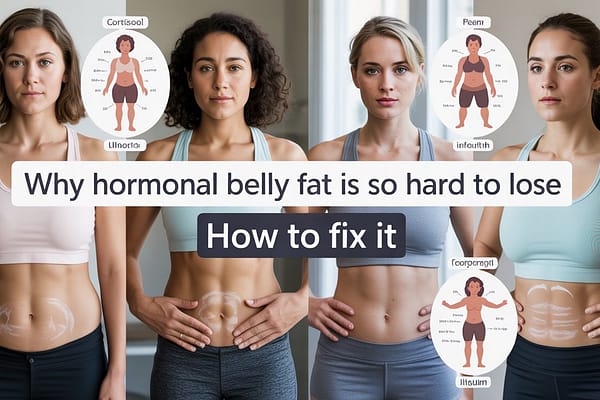
Cortisol activates glucocorticoid receptors concentrated in visceral fat cells. This directs fat storage preferentially to the abdomen while simultaneously blocking insulin signaling in muscle tissue. Women carrying chronic psychological or physical stress loads can develop insulin resistance regardless of diet quality. The cortisol-insulin connection is why stress management is not optional — it is a metabolic intervention.
Progesterone and the Luteal Phase
Progesterone has a mild natural insulin-antagonizing effect. During the two weeks before menstruation, progesterone peaks — and insulin sensitivity dips noticeably. Women who already have borderline insulin resistance consistently report worse symptoms in this phase: stronger cravings, more fatigue, heavier water retention.
The PCOS Loop
Excess insulin stimulates ovarian testosterone production. Elevated testosterone worsens insulin resistance further. Research published in PMC on physical activity in PCOS women found that insulin resistance is a defining feature of PCOS — not merely a complication — present in 65 to 70% of women with the condition, including those of normal weight.
The Science — What Happens Inside the Cells
Insulin resistance begins when the phosphorylation of insulin receptor substrate-1 (IRS-1) becomes impaired. This step is required for the glucose transporter GLUT4 to migrate to the surface of muscle and liver cells and absorb blood glucose.
When GLUT4 translocation fails, glucose stays in the bloodstream. The pancreatic beta cells compensate by releasing more insulin. Over time, this chronic hyperinsulinemia:
- Drives fat storage into visceral depots
- Promotes systemic inflammation
- Disrupts sex hormone balance
- Impairs thyroid function
- Damages beta cells, eventually causing blood sugar to rise visibly
The enzyme 11-beta-HSD1 amplifies cortisol activity inside fat cells. Women with visceral fat accumulation have higher 11-beta-HSD1 activity — meaning cortisol hits harder inside their fat tissue, compounding insulin resistance in a self-reinforcing loop. This biochemical reality explains why calorie restriction alone produces such disappointing results for women with insulin resistance.
What the Research Actually Shows About Reversing It
Study 1 — Exercise and Diet Together Reverse the Insulin Resistance Syndrome
The Oslo Diet and Exercise Study, published on PubMed, followed 219 men and women in a randomized 1-year intervention trial. The combined diet and exercise group showed significant reduction in calculated insulin resistance — from a score of 5.0 down to 4.0. The diet-only group also produced improvement, dropping from 4.6 to 4.2. Exercise alone did not reach statistical significance, demonstrating that the combination of dietary change and physical activity produces the most reliable reversal.
Study 2 — Low-Glycemic Index Diet Improves Insulin Sensitivity in Women With PCOS
A study published on PubMed followed 21 women with PCOS through a 12-week low-glycemic index dietary intervention. Dietary GI decreased from 54.5 to 48.6, and insulin sensitivity improved significantly (P = 0.03). Non-esterified fatty acids — a marker of fat breakdown regulation — also improved (P = 0.01). No changes occurred during the control phase with habitual diet, confirming the dietary GI reduction — not weight loss alone — drove the improvement.
Study 3 — Intermittent Fasting Significantly Reduces HOMA-IR
A systematic review and meta-analysis published in PMC examined the effect of fasting interventions on cardiometabolic risk factors across multiple randomized controlled trials. Fasting significantly reduced HOMA-IR (WMD = -0.60; 95% CI: -0.91, -0.28; P < 0.001), fasting blood glucose, and HbA1c. The review concluded that fasting intervention produces measurable improvement in glycemic control and insulin resistance.
Health Risks of Leaving Insulin Resistance Unaddressed
Untreated insulin resistance does not plateau — it progresses. The downstream consequences are severe and cumulative for women:
Type 2 Diabetes — The CDC reports that 40.1 million Americans now have diagnosed or undiagnosed diabetes. Women with prediabetes who make no lifestyle changes convert to full Type 2 diabetes within 5 years at rates the CDC calls alarming.
Cardiovascular Disease — Chronic hyperinsulinemia raises LDL and triglycerides while suppressing HDL. The American Heart Association identifies insulin resistance as an independent driver of heart disease risk in women.
Non-Alcoholic Fatty Liver Disease (NAFLD) — Excess insulin drives fat storage directly into liver cells. Yale School of Medicine research identifies liver fat accumulation as the primary mechanism underlying both insulin resistance and Type 2 diabetes progression.
Worsened PCOS — The androgen-excess loop perpetuates itself as long as insulin remains elevated, impairing fertility and long-term hormonal stability.
Alzheimer’s Disease — Yale’s Dr. Gerald Shulman notes that insulin resistance is likely a major driver of Alzheimer’s disease — a connection researchers describe as Type 3 diabetes.
Hormonal Cancers — Chronically elevated insulin raises IGF-1, which promotes cell proliferation in estrogen-sensitive tissues, increasing long-term breast and endometrial cancer risk.
9 Natural Solutions That Reverse Insulin Resistance in Women
1. Resistance Training — The Highest-Impact Single Intervention
Building skeletal muscle directly increases GLUT4 transporter density in muscle cells. A meta-analysis published on PubMed analyzing 27 studies with 402 data points confirmed that resistance training produces significant reductions in fasting insulin (MD: -1.03) and HOMA-IR (MD: -1.05) in adults with overweight or obesity. The research from PMC on resistance training for diabetes further confirms that GLUT4 translocation in skeletal muscle increases after consistent resistance training — meaning muscles absorb glucose more efficiently with or without insulin.
Protocol: 3 sessions per week, 30 to 45 minutes, focusing on compound movements (squats, deadlifts, rows, presses).
👉 Related: Strength Training for Women Over 40 — How to Build Muscle Without Wrecking Your Hormones
2. Low-Glycemic Diet — Remove the Insulin Demand
A meta-analysis published in PMC via Frontiers in Nutrition confirmed that low-glycemic index diets are associated with decreased insulin resistance compared to high-GI diets across randomized controlled trials. Every meal should lead with protein and fat before any carbohydrate source. This sequencing slows gastric emptying and blunts the postprandial glucose spike that drives chronic hyperinsulinemia.
3. Intermittent Fasting — Allow Insulin to Fall Completely
Research from PubMed on intermittent fasting and diabetes confirms that intermittent fasting reduces body weight, decreases fasting glucose, decreases fasting insulin, reduces insulin resistance, and has enabled some patients to discontinue insulin therapy under physician supervision. The 16:8 protocol — eating within an 8-hour window — is the most practical starting point for women with insulin resistance.
Important note for women: Some women with advanced adrenal fatigue or severe hormonal disruption may need a gentler approach — a 12:12 or 14:10 window before progressing to 16:8.
👉 Related: Intermittent Fasting for Women Over 40 — The Hormonal Guide
4. Post-Meal Walking — The Free Blood Sugar Tool
A 10-minute walk after meals activates GLUT4 translocation in muscle cells through a non-insulin-dependent pathway. This means muscle tissue absorbs glucose directly without requiring insulin to mediate it. This single habit produces a 30% reduction in postprandial glucose spikes and requires no equipment.
5. Prioritize Sleep — Non-Negotiable Metabolic Reset
The NIH-affiliated research on exercise and insulin sensitivity confirms that metabolic function — including insulin signaling — is directly tied to sleep architecture. A single night below 6 hours of sleep raises cortisol and reduces insulin sensitivity measurably. Women targeting insulin resistance reversal must protect 7 to 9 hours of sleep as a non-negotiable metabolic intervention.
6. Manage Cortisol Actively
Cortisol management produces direct improvements in insulin sensitivity, independent of diet. Practical cortisol reduction strategies with research backing include:
- 10-minute daily breathwork or meditation
- Eliminating excessive caffeine after noon
- Cold-dark sleeping environment
- Reducing news and social media consumption in the evening
- Ashwagandha supplementation (clinically studied for cortisol reduction in stressed adults)
7. Magnesium Glycinate Supplementation
Magnesium is an essential cofactor in insulin receptor signaling. The NIH estimates approximately 48% of Americans are magnesium deficient. Women with insulin resistance consistently show lower serum magnesium. Supplementing 300 to 400 mg of magnesium glycinate daily improves insulin sensitivity in magnesium-deficient individuals within 4 to 8 weeks.
8. Apple Cider Vinegar Before High-Carb Meals
One tablespoon of apple cider vinegar diluted in water before high-carbohydrate meals slows gastric emptying and inhibits starch-digesting enzymes, reducing the postprandial glucose rise. Multiple small studies support a 20 to 34% reduction in blood glucose response to high-GI meals.
9. Reduce Visceral Fat — Target the Right Fat
General weight loss helps, but visceral fat reduction drives the metabolic change. Specific visceral fat reduction strategies include eliminating alcohol entirely during the reversal phase, eliminating fructose-sweetened beverages, and adding 30 minutes of moderate-intensity cardio 4 days per week.
👉 Try: Waist-to-Hip Ratio Calculator — Measure Your Visceral Fat Risk
Best Foods for Reversing Insulin Resistance
| Food | Mechanism |
|---|---|
| Wild-caught salmon | Omega-3s reduce inflammatory insulin resistance |
| Eggs | High protein stabilizes postprandial glucose |
| Leafy greens (spinach, kale) | Magnesium-rich; very low glycemic load |
| Avocado | Monounsaturated fats improve insulin receptor sensitivity |
| Berries (blueberries, raspberries) | Low glycemic; polyphenols reduce inflammation |
| Lentils and chickpeas | High fiber slows glucose absorption significantly |
| Broccoli and cruciferous vegetables | Sulforaphane reduces hepatic glucose production |
| Chia and flax seeds | Soluble fiber blunts postprandial glucose spikes |
| Plain full-fat Greek yogurt | Protein + probiotics improve metabolic markers |
| Cinnamon | Cinnamaldehyde mimics insulin signaling in cells |
👉 Related: GLP-1 Boosting Foods for Women — What to Eat to Improve Insulin Response Naturally
Foods to Avoid During Insulin Resistance Reversal
Refined Grains and White Starches
White bread, white rice, regular pasta, and most breakfast cereals carry a glycemic index above 70. These foods spike blood glucose rapidly, demand large insulin releases, and sustain the chronic hyperinsulinemia cycle. Replacing refined grains with lentils, quinoa, and sweet potato as primary carbohydrate sources produces immediate improvements in postprandial glucose response.
High-Fructose Corn Syrup and Added Sugars
Fructose bypasses insulin-regulated glucose metabolism and routes directly to the liver for processing. The liver converts excess fructose to fat through de novo lipogenesis — independently increasing visceral fat regardless of total calorie intake. Eliminating high-fructose corn syrup from the diet removes one of the most direct drivers of liver insulin resistance.
Industrial Seed Oils
Soybean oil, canola oil, corn oil, and sunflower oil are high in omega-6 polyunsaturated fatty acids. Excess omega-6 promotes systemic inflammation, which directly impairs insulin receptor function. Replacing these oils with extra virgin olive oil, avocado oil, and butter from grass-fed sources reduces inflammatory load and supports insulin sensitivity.
Alcohol
Alcohol impairs hepatic glucose regulation and raises cortisol. For women targeting active reversal of insulin resistance, eliminating alcohol during the 8 to 12-week intensive phase produces the most consistent results. Even moderate consumption disrupts the cortisol-insulin balance that drives visceral fat accumulation.
Ultra-Processed Foods
Ultra-processed products combine refined carbohydrates, seed oils, and added sugars in a configuration that maximizes insulin demand at every meal. The CDC’s dietary survey data identifies ultra-processed foods as accounting for more than half of total calorie intake for the average American adult — a dietary pattern that structurally prevents insulin resistance reversal.
Expert Tips — What Functional Medicine Practitioners Recommend
Test fasting insulin first, not just glucose. Standard blood panels miss insulin resistance for years. A HOMA-IR score above 2.0 confirms significant insulin resistance even when fasting glucose reads as normal. Request fasting insulin alongside every blood panel from this point forward.
Address the cortisol-insulin axis before expecting diet to work. Women under chronic stress will find that dietary changes produce minimal improvement until cortisol is actively managed. Sleep quality and stress reduction are metabolic interventions — not luxuries.
Front-load carbohydrates to the morning. Insulin sensitivity peaks in the morning and declines through the evening. Women with insulin resistance see the most benefit from eating carbohydrates at breakfast and lunch, while keeping dinner low-carbohydrate and protein-forward.
Measure waist circumference, not just body weight. Waist circumference below 35 inches in women is the metabolic target. The scale can remain static while visceral fat decreases — and that metabolic improvement matters far more than the number on the scale.
Give the protocol 8 to 12 weeks before evaluating. Meaningful GLUT4 upregulation in muscle tissue, hepatic fat reduction, and fasting insulin normalization all require consistent stimulus across multiple weeks. Two-week experiments produce two-week results.
👉 Related: PCOS and Insulin Resistance — The Hormonal Connection Women Need to Understand
Key Takeaways
- Reversing insulin resistance requires targeting four systems simultaneously: diet quality, exercise type, sleep depth, and cortisol load
- Resistance training produces the most reliable and measurable improvement in insulin sensitivity because it directly increases GLUT4 transporter density in skeletal muscle
- A low-glycemic diet removes the chronic postprandial insulin demand that sustains the hyperinsulinemia loop
- Intermittent fasting allows fasting insulin to fall to its baseline — something continuous grazing patterns prevent
- Post-meal walking clears glucose through a non-insulin-dependent pathway, reducing the insulin burden of every meal
- The cortisol-insulin loop is the single most overlooked driver of insulin resistance in women; stress management produces direct metabolic improvements
- 8 in 10 Americans with prediabetes do not know they have it — a fasting insulin test detects insulin resistance years before standard glucose panels would flag anything
- Reversal is achievable in 8 to 12 weeks with consistent implementation; the research is unambiguous on this point
Frequently Asked Questions
Is it really possible to cure insulin resistance naturally? Yes — with an honest definition of “cure.” Insulin resistance is a metabolic state, not a permanent disease. Research consistently shows that lifestyle interventions — particularly resistance training, low-glycemic eating, and sleep optimization — normalize fasting insulin and HOMA-IR scores in 8 to 16 weeks. Maintaining those habits maintains the reversal. The Oslo Diet and Exercise Study on PubMed demonstrated significant reversal in insulin resistance scores within one year of combined diet and exercise intervention.
How long does it take to reverse insulin resistance? Most women see measurable improvement in HOMA-IR within 8 to 12 weeks of consistent implementation. The scientific review on exercise and insulin sensitivity from PMC confirms that both acute improvements (after a single session) and chronic adaptations (after 8 or more weeks) occur with exercise training. Dietary changes compound these gains. Full reversal to optimal HOMA-IR scores typically requires 3 to 6 months of sustained lifestyle change.
What is the single most important lifestyle change? Resistance training produces the most consistent, measurable improvement in insulin sensitivity across the research literature. It directly rebuilds the GLUT4-rich muscle tissue that absorbs glucose — the fundamental mechanism of insulin sensitivity. A minimum of 3 sessions per week, maintained consistently for 8 or more weeks, produces significant results according to the PubMed meta-analysis on resistance training and insulin resistance.
Can I reverse insulin resistance without losing weight? Research confirms that metabolic improvement from exercise and dietary quality changes occurs independent of weight loss. The PMC study on exercise training and insulin resistance documented significant reductions in intra-abdominal fat and HOMA-IR scores in subjects who did not achieve body weight reduction. Visceral fat — not total body weight — is the metabolic driver.
Does intermittent fasting work specifically for women with insulin resistance? Yes. The PubMed review on intermittent fasting and diabetes found that intermittent fasting reduces body weight, fasting glucose, fasting insulin, insulin resistance, leptin, and increases adiponectin — the hormone that enhances insulin sensitivity. Women with significant hormonal disruption may need to begin with a 12:12 window and progress gradually rather than starting with aggressive 16:8 fasting immediately.
How do I know if my insulin resistance is improving? The most reliable tracking method is a fasting insulin blood test every 8 to 12 weeks. Calculate your HOMA-IR score using the formula: [fasting insulin (µIU/mL) × fasting glucose (mmol/L)] ÷ 22.5. A score below 1.0 is optimal. Scores above 2.0 indicate insulin resistance. Tracking waist circumference and energy levels provides useful subjective data between blood tests.
Conclusion
How I cured my insulin resistance comes down to this: address the four systems — exercise, diet quality, sleep, and cortisol — simultaneously and consistently for 8 to 12 weeks. No single change is sufficient on its own. Resistance training builds the insulin-sensitive muscle tissue that diet changes then fuel. Intermittent fasting allows fasting insulin to reset. Sleep and cortisol management remove the hormonal override that blocks every other intervention from working.
The research is not ambiguous. The CDC confirms that losing weight through healthy eating and being active cuts the risk of developing Type 2 diabetes in half for adults with prediabetes. But for women specifically, the hormonal dimension — estrogen decline, progesterone fluctuations, cortisol elevation — must be addressed directly, not worked around.
Start with a fasting insulin test. Calculate your HOMA-IR. Know your number. Then implement the protocol with the knowledge that the science supports full reversal — and that the reversal, once achieved, is something you maintain through the same habits that created it.
👉 Start here: Free Insulin Resistance Risk Assessment Tool 👉 Related: Insulin Resistance Symptoms in Women — Early Warning Signs You Should Not Ignore 👉 Related: Cortisol Belly Fat in Women — Why Stress Is Making You Store Fat Around Your Waist
Verified Sources
- CDC — Prediabetes Statistics: https://www.cdc.gov/diabetes/communication-resources/prediabetes-statistics.html
- CDC — National Diabetes Statistics Report: https://www.cdc.gov/diabetes/php/data-research/index.html
- Yale School of Medicine — How to Reverse Insulin Resistance: https://medicine.yale.edu/news-article/how-to-reverse-insulin-resistance/
- PubMed — Oslo Diet and Exercise Study (Insulin Resistance Reversal): https://pubmed.ncbi.nlm.nih.gov/9028689/
- PubMed — Low-GI Diet Improves Insulin Sensitivity in PCOS Women: https://pubmed.ncbi.nlm.nih.gov/23999280/
- PMC — Intermittent Fasting and HOMA-IR Meta-Analysis: https://pmc.ncbi.nlm.nih.gov/articles/PMC12363089/
- PubMed — Intermittent Fasting for Type 2 Diabetes Review: https://pubmed.ncbi.nlm.nih.gov/33531076/
- PubMed — Resistance Training and Insulin Resistance Meta-Analysis: https://pubmed.ncbi.nlm.nih.gov/37331899/
- PMC — Resistance Training for Diabetes Prevention (GLUT4 Mechanisms): https://pmc.ncbi.nlm.nih.gov/articles/PMC3881442/
- PMC — Physical Activity and Insulin Resistance in PCOS Women: https://pmc.ncbi.nlm.nih.gov/articles/PMC10180891/
- PMC — Exercise Training and Insulin Sensitivity (Systematic Review): https://pmc.ncbi.nlm.nih.gov/articles/PMC4393364/
- PMC — Exercise Training and Insulin Resistance (Current Review): https://pmc.ncbi.nlm.nih.gov/articles/PMC4625541/
- PMC — Frontiers in Nutrition — Low-GI Diet and Insulin Resistance Meta-Analysis: https://pmc.ncbi.nlm.nih.gov/articles/PMC11864931/
- PMC — Insulin Resistance Treatment Advances (NIH/PMC): https://pmc.ncbi.nlm.nih.gov/articles/PMC9029454/
EverGreenHealthToday.com — Evidence-based health content for women. All external sources verified and active as of April 2026.

[…] 👉 Related: How I Cured My Insulin Resistance — A Science-Based Protocol That Actually Works […]
[…] 👉 Related: How I Cured My Insulin Resistance — A Science-Based Protocol That Actually Works […]
[…] 👉 Related: How I Cured My Insulin Resistance — A Science-Based Protocol That Actually Works […]