Belly Fat Not Responding to Diet or Exercise — 4 Hormones Are Working Against You — The Complete Fix for Women

Belly Fat Not Responding to Diet or Exercise — 4 Hormones Are Working Against You — The Complete Fix for Women
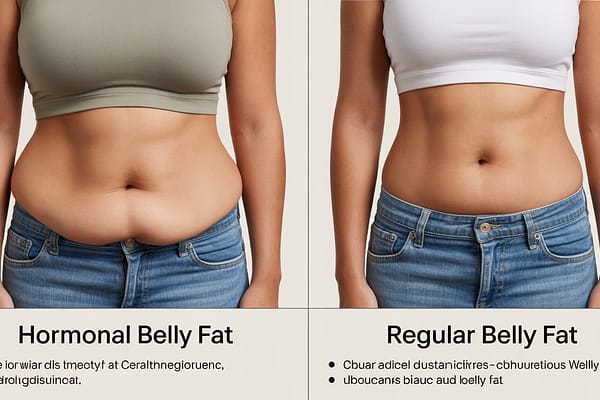
Belly fat not responding to diet or exercise in women is often driven by hormones, not just calories or motivation. When belly fat not responding to diet or exercise women experience persists, four hormones are usually involved: cortisol, declining estrogen, insulin resistance, and low GLP-1.
Traditional dieting and cardio focus on calorie balance, but they do not correct the hormonal signals that control abdominal fat storage. Identifying which hormone is driving the problem is the key to reducing stubborn belly fat effectively.
👉 Identify which of the 4 hormones is your primary driver — free Hormonal Belly Fat Risk Tool
Why Belly Fat Not Responding to Diet or Exercise Happens in Women
Belly fat not responding to diet or exercise in women usually happens because fat storage is strongly influenced by hormones, not just calorie balance. When women reduce calories or increase workouts but abdominal fat does not change, the body is often receiving hormonal signals that continue directing fat storage to the visceral belly area.
Four key hormonal mechanisms are most commonly responsible for belly fat not responding to diet or exercise women experience:
- High cortisol: Chronic stress increases abdominal fat storage and makes the body resistant to fat loss.
- Estrogen decline: Lower estrogen levels shift fat distribution toward the stomach rather than hips and thighs.
- Insulin resistance: Elevated insulin signals the body to store more fat, particularly around the abdomen.
- Low GLP-1 response: Reduced GLP-1 signaling weakens appetite control and metabolic efficiency.
Traditional weight-loss strategies like calorie restriction and cardio mainly affect total energy balance, but they do not directly correct these hormonal signals. As a result, belly fat can remain stubborn even when diet and exercise appear “perfect.”
Quick Reference — The 4 Hormonal Belly Fat Drivers
| Hormone | Direction | How It Causes Belly Fat | Primary Trigger |
|---|---|---|---|
| Cortisol | ↑ Elevated | Activates glucocorticoid receptors in visceral fat — routes storage to abdomen | Restriction, poor sleep, stress, meal skipping |
| Estrogen | ↓ Declining | Removes lower-body fat signal — cortisol becomes dominant fat-routing hormone | Perimenopause beginning age 38–45 |
| Insulin | ↑ Resistance | Visceral fat has highest insulin receptor density — stores fat preferentially there | High-glycemic diet, sedentary, PCOS |
| GLP-1 | ↓ Low | Insufficient fullness signal — caloric creep compounds all 3 other mechanisms | Protein restriction, microbiome depletion, cortisol |
Belly Fat Not Responding to Diet or Exercise — Why the Standard Approach Fails

The standard model assumes a simple caloric equation: eat less, burn more, fat reduces proportionally everywhere. This model fails for hormonal belly fat because it does not account for fat routing — the hormonal signals that determine where fat is stored and where it is released from.
Visceral adipose tissue has higher receptor densities for cortisol, insulin, and androgens than any other fat depot. It responds to hormonal signals independently of caloric balance. A woman in a genuine caloric deficit can simultaneously be accumulating visceral fat if cortisol is chronically elevated — because cortisol activates visceral storage receptors faster than the deficit releases fat from them.
Diet and exercise address caloric balance. They do not automatically address the four hormonal mechanisms routing fat to the abdomen. Those require targeted interventions.
Hormone 1 — Cortisol: The Fastest Belly Fat Not Responding Cause
The Mechanism
Cortisol activates glucocorticoid receptors densely concentrated in visceral abdominal fat. Activation produces three simultaneous effects: new fat cell differentiation in the visceral depot, increased lipid uptake in existing visceral fat cells, and inhibition of fat breakdown specifically in the abdomen.
Cortisol also directly suppresses GLP-1 — removing the fullness signal — and raises ghrelin, amplifying hunger. More eating, directed specifically toward the abdomen.
Who Is Most Affected
Women under chronic stress, sleeping under 7 hours, restricting below BMR, and skipping meals — all of these maintain chronically elevated cortisol through different mechanisms converging on the same visceral fat receptor activation.
The Fix
Sleep 7–8 hours before 10:30 PM: slow-wave sleep is the primary cortisol-clearing window. This is the single highest-impact intervention for cortisol-driven belly fat.
Morning outdoor walk (10 minutes within 60 minutes of waking): resets HPA axis cortisol pattern within 3–5 days.
Eat at TDEE minus 300–500: eliminates restriction-stress cortisol while maintaining fat loss conditions.
No caffeine after noon: eliminates afternoon cortisol extension that prevents overnight clearing.
👉 Measure your cortisol burden — free Cortisol Load Calculator
Hormone 2 — Estrogen: The Post-40 Fat Redistributor
The Mechanism
Estrogen directs fat storage to the lower body through receptor activation in subcutaneous hip and thigh tissue. As estrogen declines in perimenopause, this lower-body storage signal weakens. Cortisol becomes the dominant fat-distribution signal by default — routing storage to visceral abdominal tissue.
Estrogen also directly enhances GLP-1 secretion and receptor sensitivity. Declining estrogen removes the lower-body fat signal and reduces the fullness signal — two separate mechanisms both promoting abdominal fat accumulation simultaneously.
Who Is Most Affected
Women between ages 38 and 55 in any phase of perimenopause. The redistribution accelerates in the 2–3 years immediately preceding the final menstrual period.
👉 Identify your perimenopause stage — free Perimenopause Stage Finder
The Fix
Phytoestrogens daily: Ground flaxseed (2 tbsp), fermented soy (tempeh, miso), chickpeas — bind weakly to estrogen receptors, partially compensating for the lower-body storage signal loss.
Resistance training 3×/week: Muscle produces myokines that partially offset estrogen decline’s metabolic consequences.
Protein at 0.7–1.0g per pound bodyweight: Prevents muscle loss that compounds estrogen decline’s metabolic impact.
Direct GLP-1 restoration: Protein-first meals and the microbiome pathway carry more fullness load as estrogen-dependent amplification falls.
Hormone 3 — Insulin Resistance: The Belly Fat Storage Amplifier
The Mechanism
insulin resistance produces chronically elevated blood insulin after meals. Visceral adipose tissue has a higher concentration of insulin receptors than subcutaneous fat — meaning women with insulin resistance disproportionately accumulate belly fat from the same caloric intake.
Insulin resistance is also the central mechanism of PCOS — explaining why PCOS-related belly fat resists standard dieting despite adequate caloric restriction.
👉 Check your insulin resistance baseline — free Insulin Resistance Quiz
The Fix
HIIT twice per week: Activates GLUT4 transporters in muscle — insulin-independent glucose uptake — measurably improving peripheral insulin sensitivity within 2 weeks.
Legume at lunch daily: Lentils, chickpeas, black beans (¾ cup) — low-glycemic, sustained energy release prevents blood glucose spikes driving insulin elevation.
Vegetables before carbohydrates at meals: Reduces post-meal glucose response by 20–30%, reducing the insulin spike that routes glucose to visceral storage.
Eliminate liquid glucose: Sugary drinks and juice bypass GLP-1 satiety signals and produce the most direct insulin and visceral fat storage trigger.
Hormone 4 — Low GLP-1: The Master Lever That Ties All 4 Together
The Mechanism
Low GLP-1 does not cause belly fat directly — but it creates the conditions that allow the other three mechanisms to operate unchecked. Without adequate post-meal GLP-1 satiety, caloric intake rises, feeding the insulin-driven visceral fat accumulation. Overconsumption elevates insulin (Hormone 3). Insulin resistance drives visceral storage. Weight gain raises cortisol baseline (Hormone 1). Cortisol suppresses GLP-1 further, completing the loop.
GLP-1 is estrogen-sensitive (Hormone 2), cortisol-suppressed (Hormone 1), and microbiome-dependent. Every other mechanism in this article either reduces GLP-1 or depends on its absence to perpetuate itself. Restoring GLP-1 interrupts all four feedback loops simultaneously.
The Fix
Protein-first at every meal (30–40g): Direct amino acid stimulation of gut L cells — independent of estrogen or cortisol status.
Premeal strategy: ½ cup Greek yogurt 20–30 minutes before lunch and dinner — increases active GLP-1 by up to 298%.
Legume at lunch daily: SCFA microbiome fermentation pathway — estrogen-independent baseline GLP-1 source.
Fermented food daily: Greek yogurt, kefir, sauerkraut — seeds and maintains SCFA-producing gut bacteria.
(14-day complete GLP-1 restoration: 14-Day GLP-1 Reset for Women)
The Complete Daily Protocol
| Time | Action | Hormone Targeted |
|---|---|---|
| On waking | 10-min outdoor walk | Cortisol (reset HPA axis) |
| Within 60 min | Breakfast: 30–40g protein | GLP-1 (direct L cell activation) |
| 20 min before lunch | ½ cup Greek yogurt | GLP-1 (+298% at meal) |
| Lunch | Legume ¾ cup + protein + vegetables first | Insulin + GLP-1 + microbiome |
| No caffeine after noon | — | Cortisol (eliminate extension) |
| 20 min before dinner | ½ cup cottage cheese | GLP-1 (premeal amplification) |
| Dinner | Protein first, finish by 7 PM | GLP-1 + Cortisol |
| Before bed | Magnesium glycinate 200–400mg | Cortisol + slow-wave sleep |
| Bedtime | Before 10:30 PM, 7–8 hours | Cortisol (clearing window) |
| Weekly | HIIT ×2, resistance training ×3 | Insulin + GLP-1 + BMR |
Key Takeaways
- Belly fat not responding to diet or exercise is driven by 4 simultaneous hormonal mechanisms — each with specific, targeted interventions that standard restriction and cardio do not address.
- Cortisol is the most immediately actionable driver — sleep, meal timing, adequate calories, and caffeine timing reduce it within days.
- GLP-1 is the master lever — restoring it through protein-first meals, the premeal strategy, and microbiome rebuilding interrupts all four feedback loops simultaneously.
- The complete protocol addresses all 4 mechanisms through daily dietary structure and weekly exercise — without extreme restriction that would worsen the cortisol mechanism.
Frequently Asked Questions
Q: How do I know which of the 4 hormones is my primary driver? The hormonal belly fat Risk Tool above assesses all four based on your specific symptom pattern, lifestyle, and hormonal context. Common profiles: women under 40 with high stress → cortisol dominant; women 40–55 → estrogen + cortisol combination; PCOS → insulin dominant; repeated dieters → GLP-1 + cortisol combination.
Q: How quickly can hormonal belly fat reduce? Cortisol reduction from sleep begins within days. GLP-1 restoration begins at 7–14 days. Insulin sensitivity improvement from HIIT begins at 2 weeks. Visible waist circumference reduction typically begins at 6–8 weeks and accelerates through weeks 12–16.
Q: Does HRT help with estrogen-related belly fat? Research shows HRT reduces the fat redistribution occurring during the menopausal transition. It is a medical decision requiring individual assessment. The protocol above works independently of HRT and can be combined with it.
Read More in This Series
- 👉 Belly Fat Appearing After 40 Without Eating More — Estrogen Declined
- 👉 Belly Fat Growing Despite Dieting — High Cortisol Is Directing Fat to Your Abdomen
- 👉 Waking Hungry Every Morning Despite Eating Enough — Poor Sleep Is Collapsing GLP-1
- 👉 Metabolism Slowing After 40 — Estrogen Drop Destroyed GLP-1 Sensitivity
- 👉 Natural GLP-1 Foods That Work Like Ozempic for Women
Free Tools
👉 Hormonal Belly Fat Risk Tool | 👉 Cortisol Load Calculator | 👉 Insulin Resistance Quiz | 👉 Perimenopause Stage Finder | 👉 What’s Causing My Weight Gain | 👉 TDEE Calculator
Research Sources: • PMC — Estrogen and Visceral Fat Redistribution in Perimenopause (PMC3466797) • PubMed — Glucocorticoids Suppress GLP-1 and Drive Visceral Fat (Kappe et al., PMID 25853863) • PMC — HIIT Improves Insulin Sensitivity Independent of Weight Loss (PMC6107470) • PubMed — Whey Premeal Increases Active GLP-1 298% (PMID 25005331) • Endocrine Society — Visceral Adipose Tissue Receptor Distribution and Hormonal Sensitivity (2023)

[…] 👉 Belly Fat Not Responding to Diet or Exercise — 4 Hormones Are Working Against You […]
[…] 👉 Belly Fat Not Responding to Diet or Exercise — 4 Hormones Are Working Against You […]
[…] (Cortisol from over-exercise worsens belly fat: Belly Fat Not Responding to Diet or Exercise — 4 Hormones) […]